OSHA 29 CFR 1910.1200
Your written HazCom program, in plain words
Plans from $199 a month. No per-person fees. 14 days free.
Rather have us write it? Two written programs ($295)
Written by a safety team holding BCSP STS and NFPA 70E credentials.
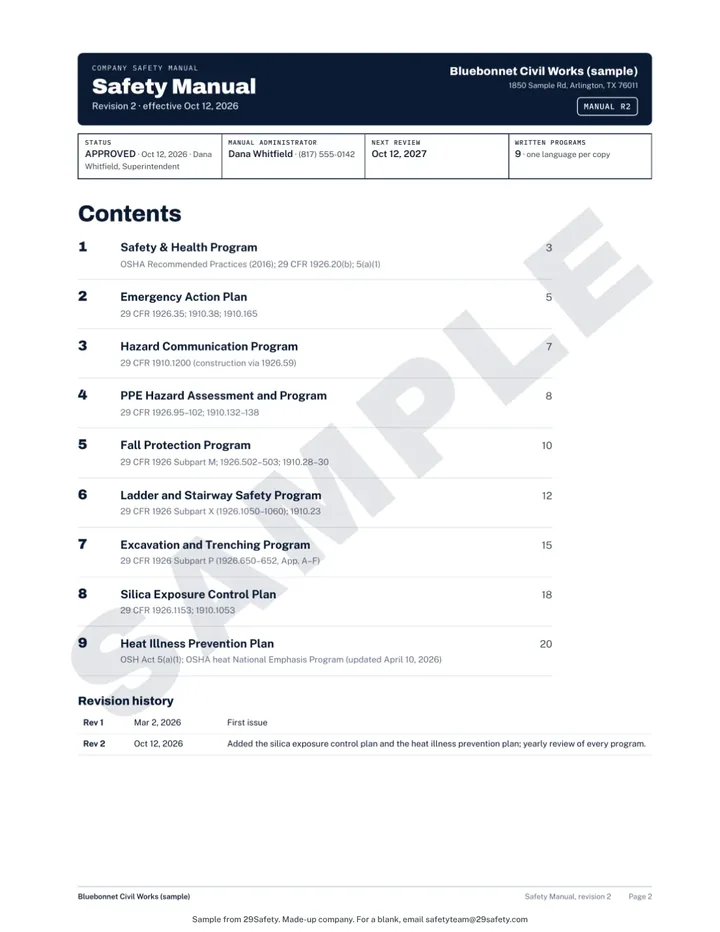
See a finished oneTalk to the safety team
The written hazard communication program OSHA asks for, filled in with your company and cited to 1910.1200. Every chemical with its SDS one tap away, and secondary-container labels that print. English and Spanish.
What's in your HazCom program
If your people can be exposed to hazardous chemicals at work, you need a written hazard communication program at each workplace (1910.1200(e)(1)). These are the parts the rule requires, and what 29Safety gives you for each.
Your chemical list
A list of the hazardous chemicals at your workplace, by the product name on each safety data sheet. One list for the whole site, or one for each work area.
1910.1200(e)(1)(i)Labels on every container
Shipped containers keep the maker's label, and nobody removes or defaces it. Secondary containers get a workplace label with the product name and its hazards, unless one person fills it and uses it right away. 29Safety prints the secondary-container labels.
1910.1200(f)(6), (f)(8), (f)(9)Safety data sheets people can reach
An SDS for every hazardous chemical, readily accessible to your people on every shift. Electronic access is fine as long as nothing stands in the way. In 29Safety every chemical has its SDS one tap away.
1910.1200(g)(8)Training at the start, and when something new comes in
Training at a worker's first assignment and whenever a new chemical hazard comes into their area: how to spot a release, the hazards, how to protect themselves, and how your labels and SDSs work. HazCom training sits in the training tracker with everything else.
1910.1200(h)Jobs you don't do every day
How you warn people about the hazards of non-routine tasks, like cleaning out a tank, and of chemicals in unlabeled pipes in their area. A JHA for the non-routine job puts it on paper.
1910.1200(e)(1)(ii)Contractors on your site
When another employer's people could be exposed to your chemicals, your program says how they get to your SDSs, what precautions they need in normal work and in an emergency, and how your labels work.
1910.1200(e)(2)Ready when someone asks
The written program is available to employees, their representatives and OSHA when they ask for it. If your people travel between sites during a shift, it can stay at the main location.
1910.1200(e)(4), (e)(5)HazCom is one of the written programs 29Safety builds for plants and shops, next to lockout, forklifts, respiratory protection and more. See the full list, rule by rule, in our written programs guide.
See exactly what you'd get
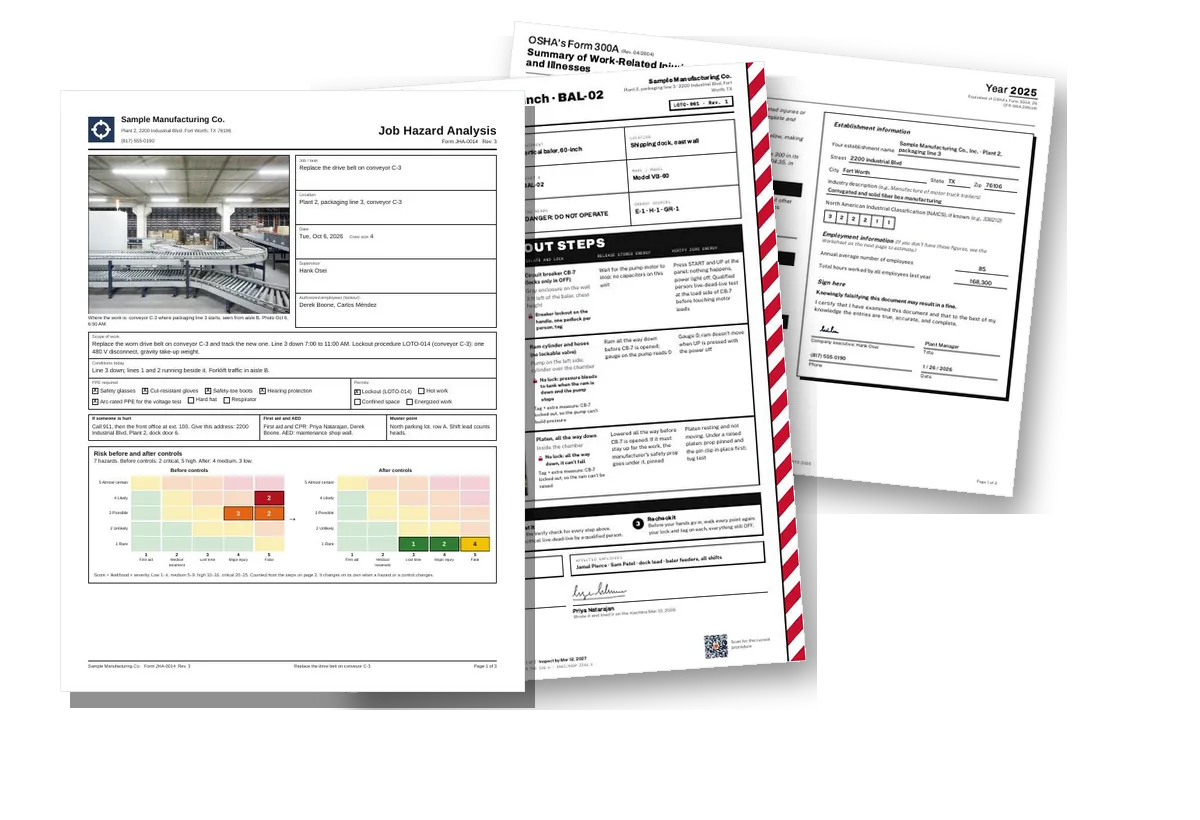
Three finished documents for a made-up plant, straight out of 29Safety: a job hazard analysis for a conveyor drive belt change, a lockout placard for a vertical baler with the verify-zero-energy steps, and a filled OSHA Form 300A summary. 8 pages, no watermark.
Or look through 11 finished documents first, no email needed
From sign-up to a posted lockout procedure before the shift ends
Tell us about your work
Your state, your crew size, and what you run: presses, conveyors, forklifts, chemicals. About 12 plain questions. No safety jargon.
About 5 minutesGet your programs
29Safety builds your written programs (lockout, HazCom, forklifts, emergency action) cited to 29 CFR 1910, plus a month of safety talks. Edit anything.
About 2 minutesFinish it on the floor
Pick a machine template, walk the machine, and add your photos and disconnect numbers. Print the placard and post it; its QR code always opens the current version.
Every day after
One price for the whole company
No per-person fees and no setup charge. Every plan includes every feature; plans differ by how many workers they cover, how much Harli can do each month, and storage.
How the free trial works
- Day 1Sign up. Nothing is charged today. Build your first written program.
- Days 1 to 14Build your programs, JHAs, toolbox talks and records.
One trial per company. If the email address used to sign up already had a free trial, there is no trial: the plan starts, and is charged, the day you sign up.
A build is a document Harli writes for you: a JHA, a toolbox talk, a program. Prices in US dollars. Payments by Stripe.
Rather have us write it?
The 29Safety safety team writes your programs, manual and site plan, filled in with your company. No account needed: Two written programs ($295), Bid and prequal packet ($795) and Full safety program ($2,495).
Questions
Anything else: safetyteam@29safety.com, or book a free 15-minute call.
Who needs a written HazCom program?
Can the safety data sheets be on a phone?
Do labels have to be in Spanish?
OSHA updated HazCom in 2024. What's due, and when?
Does 29Safety guarantee we pass an OSHA inspection?
Your HazCom program, in plain words, today.
Your first written program is ready about 10 minutes after you sign up.