OSHA recordkeeping, 29 CFR Part 1904
OSHA 300, 300A and 301 logs that build themselves
Plans from $199 a month. No per-person fees. 14 days free.
Rather have us write it? Two written programs ($295)
Written by a safety team holding BCSP STS and NFPA 70E credentials.
See a finished oneTalk to the safety team
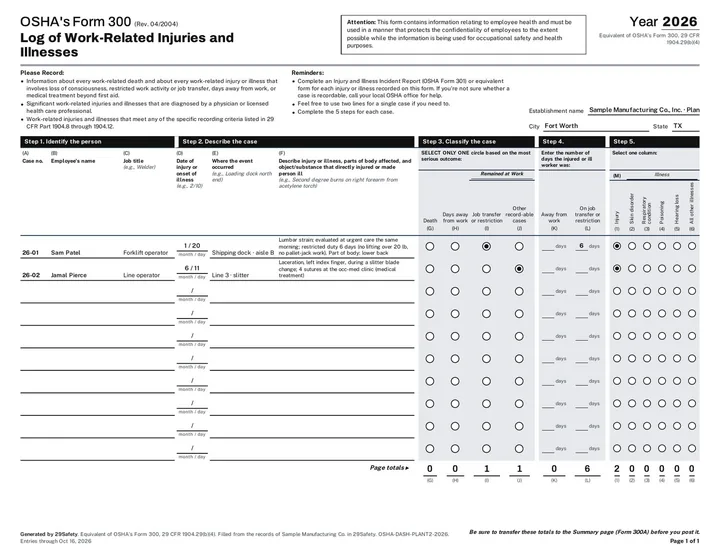
Report the incident from a phone. 29Safety asks the first-aid questions in order, gives you the answer with the rule cited, and fills in the 300, 301 and 300A, with your TRIR and DART.
What's in your OSHA recordkeeping
A company with more than 10 employees at any time last year keeps injury and illness records, unless its industry is on OSHA's partially exempt list (1904.1, 1904.2). These are the parts the rule requires, and what 29Safety gives you for each.
Who keeps the log
Every company that had more than 10 employees at any time during the last calendar year, counted across the whole company, unless the establishment's industry is on the partially exempt list. Construction, manufacturing and warehousing are not on it.
1904.1, 1904.2What goes on the log
A work-related case that ends in death, days away, restricted work or a job transfer, medical treatment beyond first aid, loss of consciousness, or a significant injury or illness diagnosed by a doctor or other licensed health care professional. 29Safety asks the questions in order and gives the answer with the rule cited.
1904.7Seven calendar days
Each recordable case goes on the 300 log, with its 301 incident report, within 7 calendar days of when you learn about it. The foreman reports from the phone with photos, and the 300 and 301 fill themselves in.
1904.29(b)(3)Privacy cases
On the cases OSHA lists, you write “privacy case” where the name would go and keep the names on a separate confidential list. The list: intimate body parts, sexual assault, mental illness, HIV, hepatitis or tuberculosis, contaminated needlesticks and sharps, and any illness the employee asks to keep private. The description can leave out private details.
1904.29(b)(6)-(9)The 300A, posted February 1 to April 30
At year end the log is reviewed and totaled, and a company executive signs off that the summary is correct and complete. Post it where you post notices from February 1 to April 30, with zeros if you had no cases. The 300A is ready to print and sign on February 1.
1904.32Electronic submission by March 2
Covered establishments send their 300A data to OSHA by March 2: 20 to 249 employees in the industries on Appendix A to Subpart E, or 250 or more in any industry that keeps records. With 100 or more in Appendix B industries, the 300 and 301 data go too. The counts are there for the March 2 submission.
1904.41Five years, and the records are yours
Keep the 300 log, the privacy case list, the 300A and the 301s for five years after the year they cover, and update the 300 when a case changes. The records belong to your company, and they download as PDF or spreadsheet files.
1904.33TRIR and DART
Your total recordable case rate and DART rate, figured the way OSHA's forms package does it: cases times 200,000, divided by the hours everyone worked. DART counts only the cases with days away, or with restricted work or a job transfer.
OSHA recordkeeping forms packageSee a filled OSHA 300 log, 300A summary and 301 report for a made-up plant, or read the dates you can't miss.
See exactly what you'd get
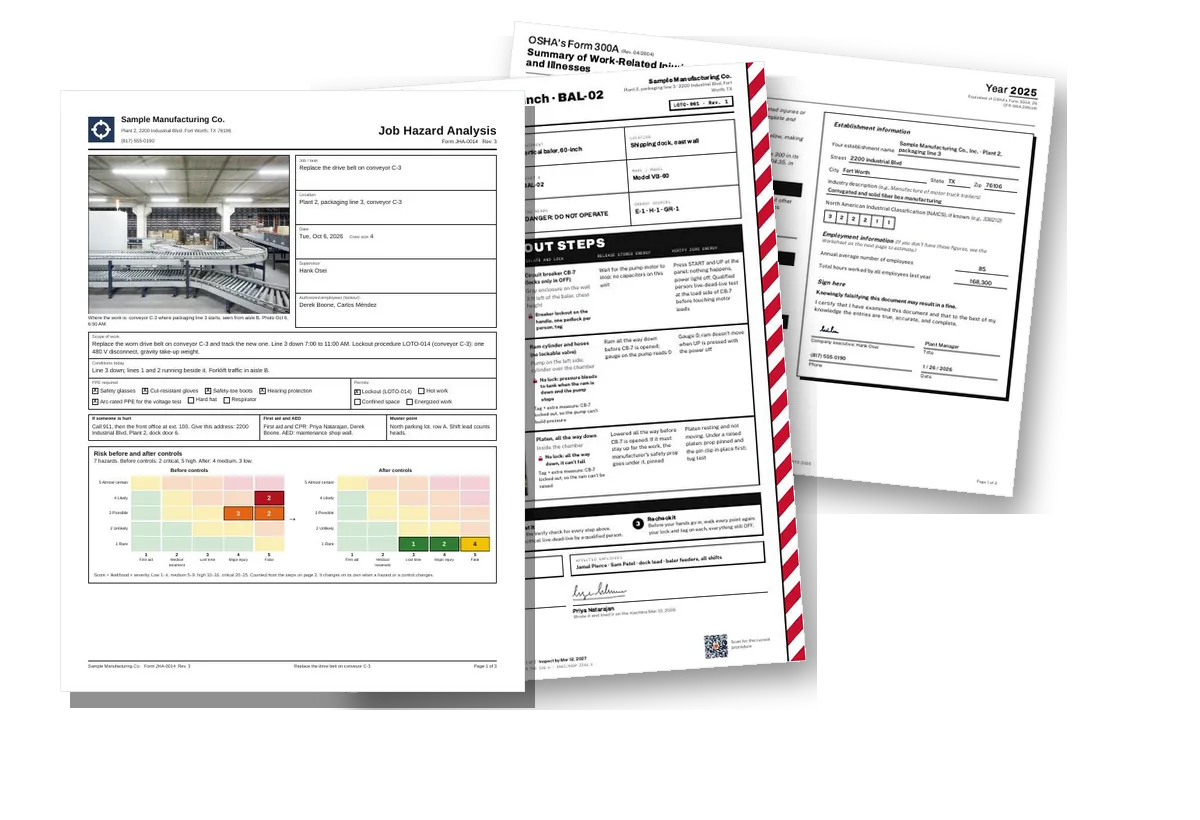
Three finished documents for a made-up plant, straight out of 29Safety: a job hazard analysis for a conveyor drive belt change, a lockout placard for a vertical baler with the verify-zero-energy steps, and a filled OSHA Form 300A summary. 8 pages, no watermark.
Or look through 11 finished documents first, no email needed
From sign-up to a posted lockout procedure before the shift ends
Tell us about your work
Your state, your crew size, and what you run: presses, conveyors, forklifts, chemicals. About 12 plain questions. No safety jargon.
About 5 minutesGet your programs
29Safety builds your written programs (lockout, HazCom, forklifts, emergency action) cited to 29 CFR 1910, plus a month of safety talks. Edit anything.
About 2 minutesFinish it on the floor
Pick a machine template, walk the machine, and add your photos and disconnect numbers. Print the placard and post it; its QR code always opens the current version.
Every day after
One price for the whole company
No per-person fees and no setup charge. Every plan includes every feature; plans differ by how many workers they cover, how much Harli can do each month, and storage.
How the free trial works
- Day 1Sign up. Nothing is charged today. Build your first written program.
- Days 1 to 14Build your programs, JHAs, toolbox talks and records.
One trial per company. If the email address used to sign up already had a free trial, there is no trial: the plan starts, and is charged, the day you sign up.
A build is a document Harli writes for you: a JHA, a toolbox talk, a program. Prices in US dollars. Payments by Stripe.
Rather have us write it?
The 29Safety safety team writes your programs, manual and site plan, filled in with your company. No account needed: Two written programs ($295), Bid and prequal packet ($795) and Full safety program ($2,495).
Questions
Anything else: safetyteam@29safety.com, or book a free 15-minute call.
Do I need an OSHA 300 log with 12 employees?
Do I post the 300A if we had no injuries?
Is the log the same as calling OSHA after a serious injury?
Who owns the logs?
Does 29Safety guarantee our logs are right?
Your OSHA logs, built from your incident reports.
Your first written program is ready about 10 minutes after you sign up.