Construction, built from your 1926 program
Site-specific safety plan for your next job
Plans from $199 a month. No per-person fees. 14 days free.
Rather have us write it? Two written programs ($295)
Written by a safety team holding BCSP STS and NFPA 70E credentials.
See a finished oneTalk to the safety team
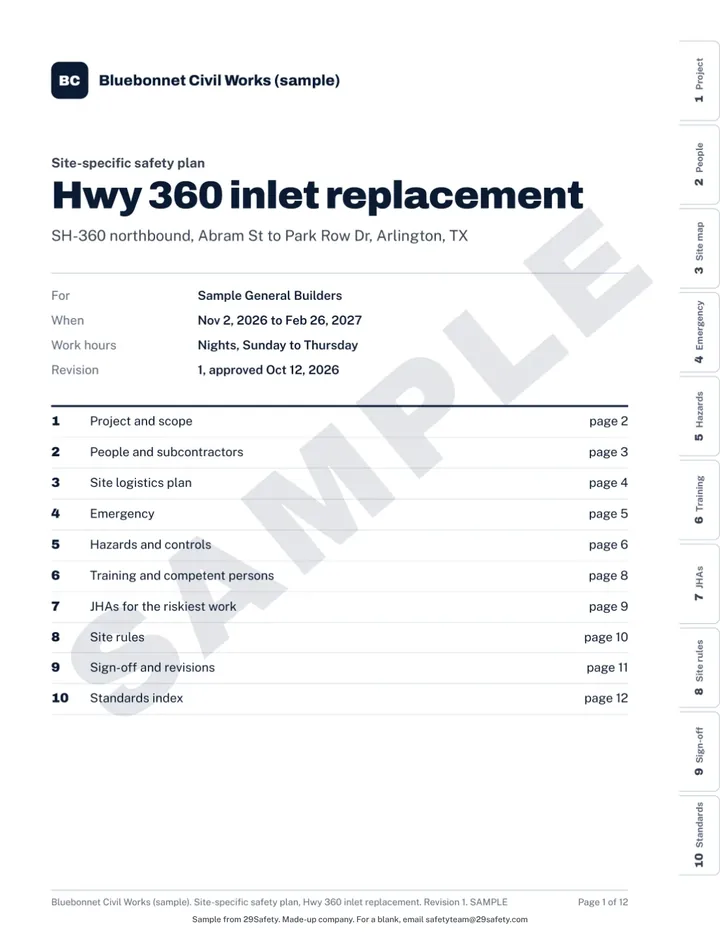
One plan per job, built from your written program: scope, site contacts, competent persons, the hazards by phase, emergency information and the crew's sign-offs. The GC gets it before you mobilize, not after the first walk-through.
What's in your site-specific safety plan
No OSHA standard asks for a document called a site-specific safety plan. The general contractor or the owner asks for it in the contract, usually before anyone gets a badge. Each part draws on rules you already follow under 29 CFR 1926. These are the parts, and the rule behind each.
Project and scope
The project name, address, GC and owner exactly as the contract writes them, the dates, and a plain paragraph on what your crew will do and with what equipment.
From the contractSite contacts
The project manager, superintendent, foreman and safety contact for this job, so the GC and your crew know who to call.
From your crew listCompetent persons
The competent persons you designate for this job, by hazard: excavation, scaffolds, fall protection, silica. Each one can spot the hazards and has the authority to fix them on the spot.
1926.20(b)(2), 1926.32(f)Hazards by phase
Mobilization through demobilization: the main hazards and controls in each phase, and the JHA from your library that covers it. Only the sections for hazards on this job.
1926.21(b)(2); the job's JHAsEmergency information
The nearest emergency room and the route from the gate, who calls 911, the muster point, the first aid kit and who holds a first aid card. Arranged before the project starts.
1926.50(b), (c), (f); 1926.35Training and orientation
The site orientation in the crew's language, with the sign-in, and the cards the job needs, like OSHA 10 and 30 and the fall protection training record.
1926.21(b)(2), 1926.503(b)Incident reporting
Who the crew tells, who tells the GC and by when, and the calls to OSHA: within 8 hours for a death, within 24 hours for an in-patient hospitalization, an amputation or the loss of an eye.
1904.39(a)Sign-offs
The crew's sign-offs that they went over the plan, the owner or officer who approved it, the superintendent who will run it, the date and a revision log.
Many GC exhibits ask for themRead the full site-specific safety plan guide, or see a filled prequal packet, the stack a GC asks to see next to the plan.
The OSHA rules the plan pulls from
An SSSP is a contract document, not one OSHA standard. Every section rests on a duty you already have. Under 1926.16 the prime contractor keeps overall responsibility for the work it subcontracts, which is why the GC reads your plan.
Programs and inspections
Start and keep up the programs Part 1926 needs, with frequent and regular inspections of the site, materials and equipment by competent persons you designate.
1926.20(b)(1), (2)Medical help before the job starts
Prompt medical attention arranged before the project begins, a person with a first-aid card on site when no clinic or hospital is reasonably close, and the site's location posted where 911 can't get it from the phone.
1926.50(b), (c), (f)Emergency action plan
Where a standard calls for one: escape procedures, accounting for everyone, rescue and medical duties, and how to report an emergency. It may be oral with 10 or fewer employees.
1926.35Excavation
Utilities located before digging, a protective system, and a competent person's inspection before work starts and after every rain.
1926.651(b), (k); 1926.652(a)Silica
The tasks on this job from your written exposure control plan, the controls for each, and the competent person who runs it.
1926.1153(g)Hazard communication
The chemicals and safety data sheets for this job, and how other employers on the site get access to your SDSs.
1926.59, 1910.1200(e)(2)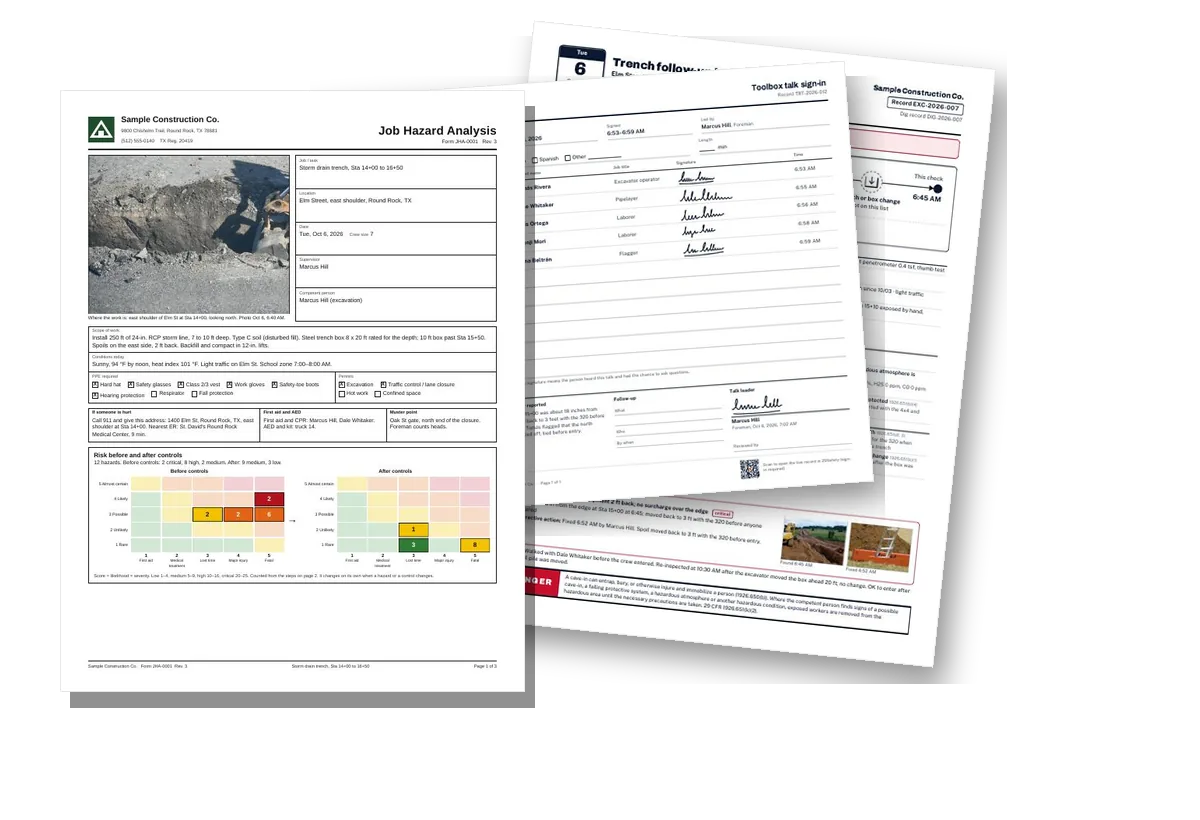
See exactly what you'd get
Five finished documents for a made-up jobsite crew, straight out of 29Safety: a job hazard analysis for a storm drain trench, a toolbox talk record the crew signed on their phones, a daily trench inspection, a competent person designation, and the prequalification packet a GC asks for. 21 pages, no watermark.
Or look through 11 finished documents first, no email needed
From signup to a signed JHA before the first coffee break
Tell us about your work
Pick your trades, your state, and your crew size. Answer about 12 plain questions. No safety jargon.
About 5 minutesGet your programs
29Safety builds your written program, JHAs, and first month of toolbox talks, with the OSHA rule cited on every line. Edit anything.
About 2 minutesRun it from the jobsite
Crews sign off on their phones, even with no signal. Training alerts and your prequal packet stay current on their own.
Every day after
One price for the whole company
No per-person fees and no setup charge. Every plan includes every feature; plans differ by how many workers they cover, how much Harli can do each month, and storage.
How the free trial works
- Day 1Sign up. Nothing is charged today. Build your first written program.
- Days 1 to 14Build your programs, JHAs, toolbox talks and records.
One trial per company. If the email address used to sign up already had a free trial, there is no trial: the plan starts, and is charged, the day you sign up.
A build is a document Harli writes for you: a JHA, a toolbox talk, a program. Prices in US dollars. Payments by Stripe.
Rather have us write it?
The 29Safety safety team writes your programs, manual and site plan, filled in with your company. No account needed: Two written programs ($295), Bid and prequal packet ($795) and Full safety program ($2,495).
Questions
Anything else: safetyteam@29safety.com, or book a free 15-minute call.
Does OSHA require a site-specific safety plan?
Can we use the GC's template?
Who signs the plan?
Does 29Safety guarantee the GC accepts our plan?
How long does it take?
Your next site plan, built from your program.
Your first written program is ready about 10 minutes after you sign up.