How many locks, before anything else
The number of lockout points, the procedure number and the revision sit at the top, so nobody starts with one lock short.
This is what 29Safety prints for a machine, filled out for a made-up plant: a two-sided placard that hangs at the machine. Scroll and the page follows along. Switch to Spanish any time.
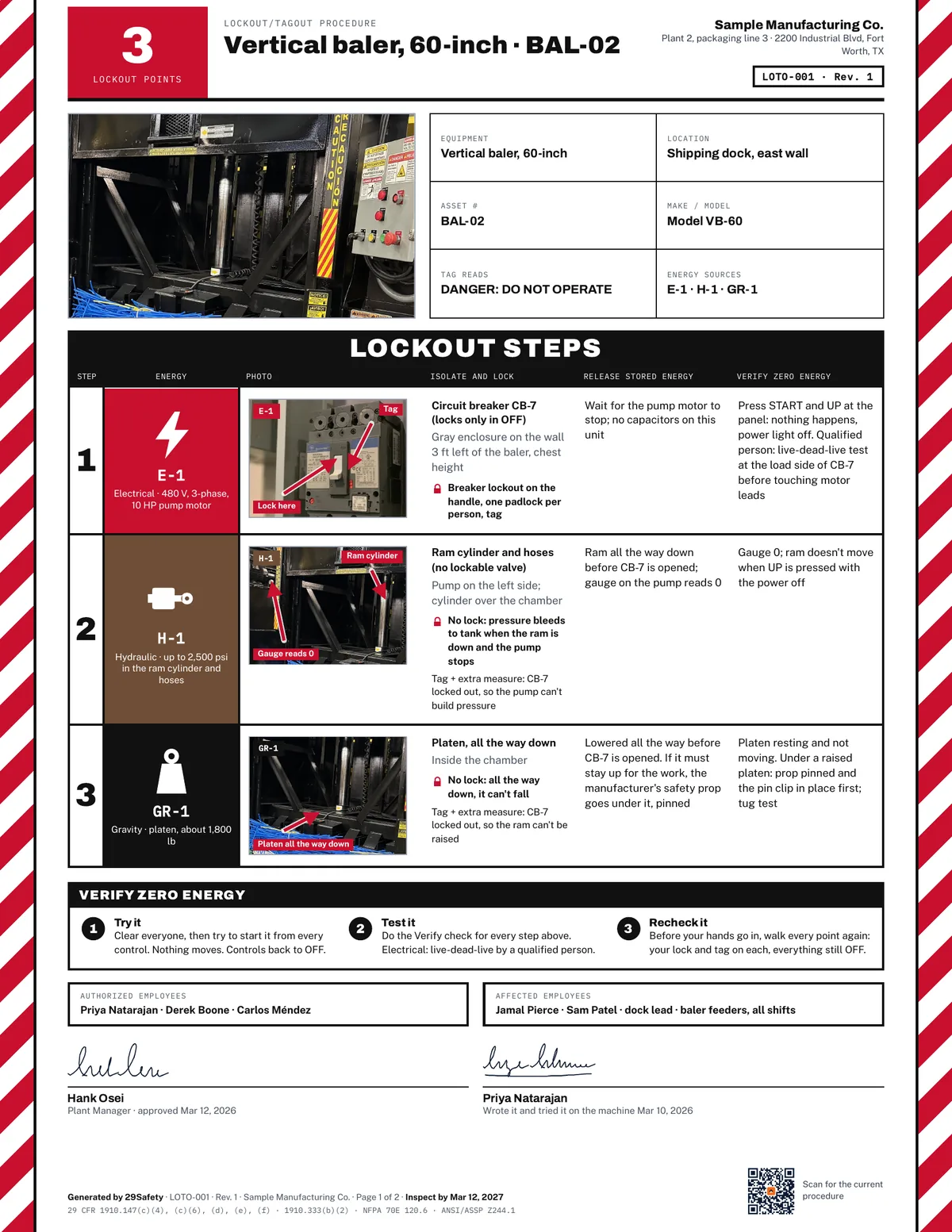
The number of lockout points, the procedure number and the revision sit at the top, so nobody starts with one lock short.
A photo of the machine, where it is, its asset number, what the tag says, and every energy source by code.
Electrical, hydraulic, gravity: each gets a color, a code (E-1, H-1, GR-1) and its size, like 480 volts or 2,500 psi.
Your own photo of each breaker, disconnect or valve, with arrows to where the lock and the tag go. A new hire puts the lock in the right place.
For each point: how to isolate and lock it, how to release what's stored, and how to prove it's at zero.
Before anyone reaches in: try every control, test with a meter (live-dead-live on anything electrical), and walk every point again.
Authorized and affected employees by name, the approval signature, and the person who tried it on the machine.
Scan it and the procedure opens as it stands now, so an old copy taped to the machine can't fool anyone.
Seven steps from getting ready to verifying zero energy, filled in with this machine's points and people.
Test the meter on a known live source, test every conductor at the point of work, then test the meter again. If the last test fails, the dead reading doesn't count.
Check the machine, clear the area, controls off, each person takes off only their own lock, and everyone hears before it starts.
The rules for the jobs where lockout goes wrong most: more than one crew, a shift change in the middle, outside contractors.
Start the free trial and build the first procedure from a template for your machine. You walk it and add your own photos.
14 days free.