OSHA 29 CFR 1910.147
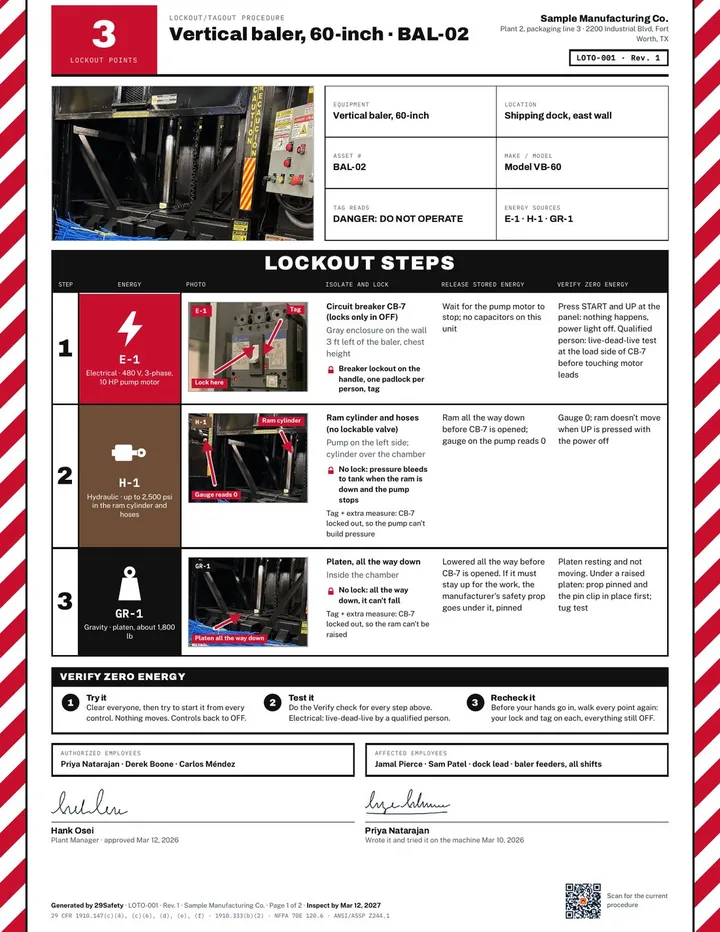
Machine-specific lockout/tagout steps, with your photos
Plans from $199 a month. No per-person fees. 14 days free.
Rather have us write it? Two written programs ($295)
Written by a safety team holding BCSP STS and NFPA 70E credentials.
See a finished oneTalk to the safety team
Start each lockout procedure from a template for the machine. Add your photos and your devices, then print the placard. A written energy control program plus a procedure for every machine, cited to 1910.147, in English and Spanish.
What's in your lockout/tagout program
If your people service or maintain machines where an unexpected startup or stored energy could hurt them, OSHA requires an energy control program: procedures, training and periodic inspections (1910.147(c)(1)). These are the parts the rule requires, and what 29Safety gives you for each.
A procedure for each machine
Each one says what it covers, how to shut down, isolate, block and secure the machine, how locks and tags go on, come off and change hands, and how to test that it worked. Start from a template: conveyor, press, compressor, packaging line, CNC, saw, mixer, boiler and more.
1910.147(c)(4)(ii)Every isolation point, with your photo
A code and a photo for every isolation point (E-1, P-1 and so on), so a new hire finds the right disconnect. Add your disconnect numbers and valve locations. Nothing can be approved until every point is checked at the machine.
1910.147(d)(3)The steps in OSHA's order
The rule sets the order: get ready, shut down, isolate, lock and tag, release stored energy, then verify. The template has the steps in that order, and the checks are written in: try it, test it, recheck it, with live-dead-live on every electrical check.
1910.147(d)Locks, tags and devices
For each point, the device and how it goes on: breaker lockout, padlock, tag. The rule wants lockout devices used only for lockout, standardized by color, shape or size, durable, hard to remove without bolt cutters, and marked with the name of the person who put them on.
1910.147(c)(5)Back in service
Check the machine, clear the area, tell the affected people, and each person takes off only their own lock. If the person who put a lock on has left, the rule allows removal only under a written procedure: confirm they're gone, try to reach them, and tell them before they're back at work.
1910.147(e)Crews, shift changes and contractors
Group lockout puts one authorized employee in charge, with each person's own lock on the group box. At shift change the protection is handed over in order. Outside contractors and you tell each other your procedures. The placard covers all three.
1910.147(f)(2)-(4)An inspection every year
At least once a year, an authorized employee who isn't using the procedure inspects it, and you record the machine, the date, the people included and the inspector. 29Safety tracks each one with a due date.
1910.147(c)(6)Training, by name and date
Authorized employees learn the energy sources and how to control them, affected employees learn what the procedure is for, and everyone else learns to leave locks alone. Names and training dates sit on each procedure, and a change flags the people who use it for retraining.
1910.147(c)(7)Every procedure prints as a placard in English and Spanish, with a QR code that always opens the current version. See a full sample, point by point, open the sample placard (PDF), or read our lockout procedure guide.
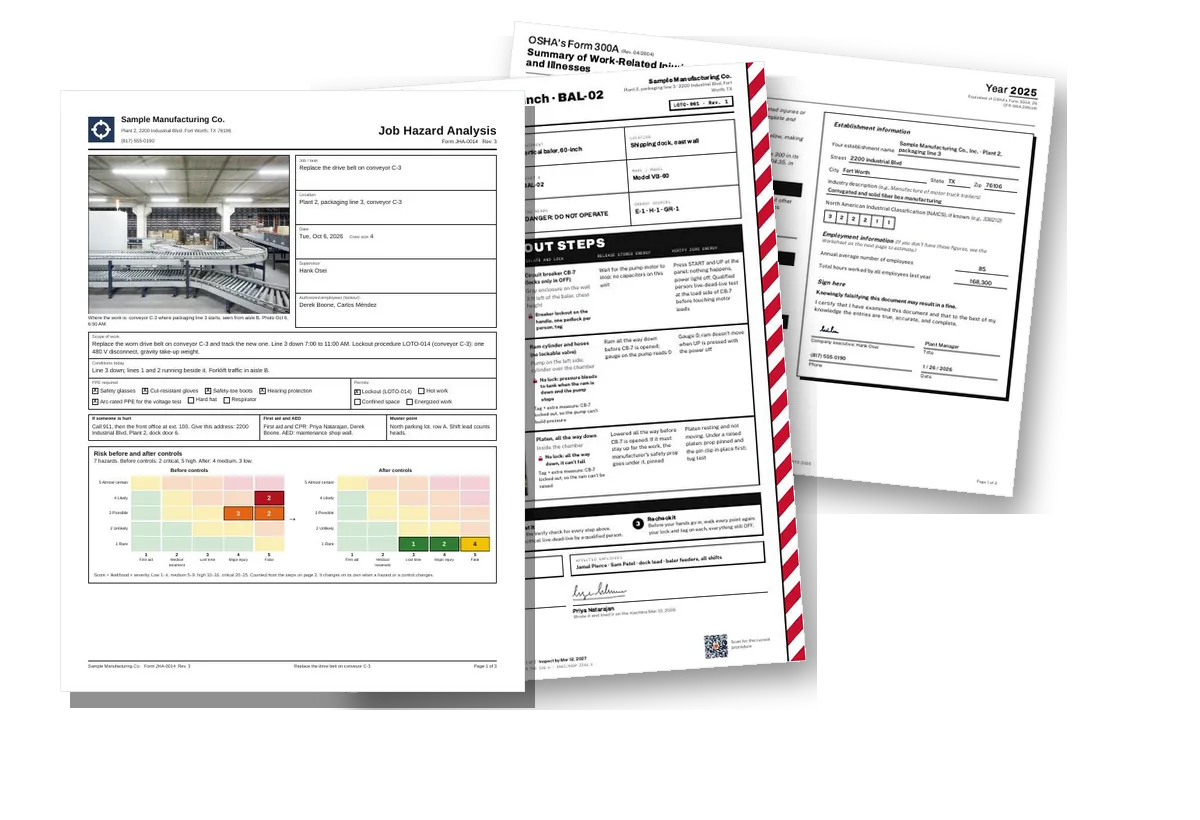
See exactly what you'd get
Three finished documents for a made-up plant, straight out of 29Safety: a job hazard analysis for a conveyor drive belt change, a lockout placard for a vertical baler with the verify-zero-energy steps, and a filled OSHA Form 300A summary. 8 pages, no watermark.
Or look through 11 finished documents first, no email needed
From sign-up to a posted lockout procedure before the shift ends
Tell us about your work
Your state, your crew size, and what you run: presses, conveyors, forklifts, chemicals. About 12 plain questions. No safety jargon.
About 5 minutesGet your programs
29Safety builds your written programs (lockout, HazCom, forklifts, emergency action) cited to 29 CFR 1910, plus a month of safety talks. Edit anything.
About 2 minutesFinish it on the floor
Pick a machine template, walk the machine, and add your photos and disconnect numbers. Print the placard and post it; its QR code always opens the current version.
Every day after
One price for the whole company
No per-person fees and no setup charge. Every plan includes every feature; plans differ by how many workers they cover, how much Harli can do each month, and storage.
How the free trial works
- Day 1Sign up. Nothing is charged today. Build your first written program.
- Days 1 to 14Build your programs, JHAs, toolbox talks and records.
One trial per company. If the email address used to sign up already had a free trial, there is no trial: the plan starts, and is charged, the day you sign up.
A build is a document Harli writes for you: a JHA, a toolbox talk, a program. Prices in US dollars. Payments by Stripe.
Rather have us write it?
The 29Safety safety team writes your programs, manual and site plan, filled in with your company. No account needed: Two written programs ($295), Bid and prequal packet ($795) and Full safety program ($2,495).
Questions
Anything else: safetyteam@29safety.com, or book a free 15-minute call.
Do I need a written procedure for every machine?
Does 29Safety write the lockout procedures for me?
How often does each procedure have to be inspected?
Does 29Safety guarantee we pass an OSHA inspection?
How long does it take?
A lockout procedure for every machine, starting today.
Your first written program is ready about 10 minutes after you sign up.